The Anatomy of a Studio Implosion

Source check: 27 July 2026.
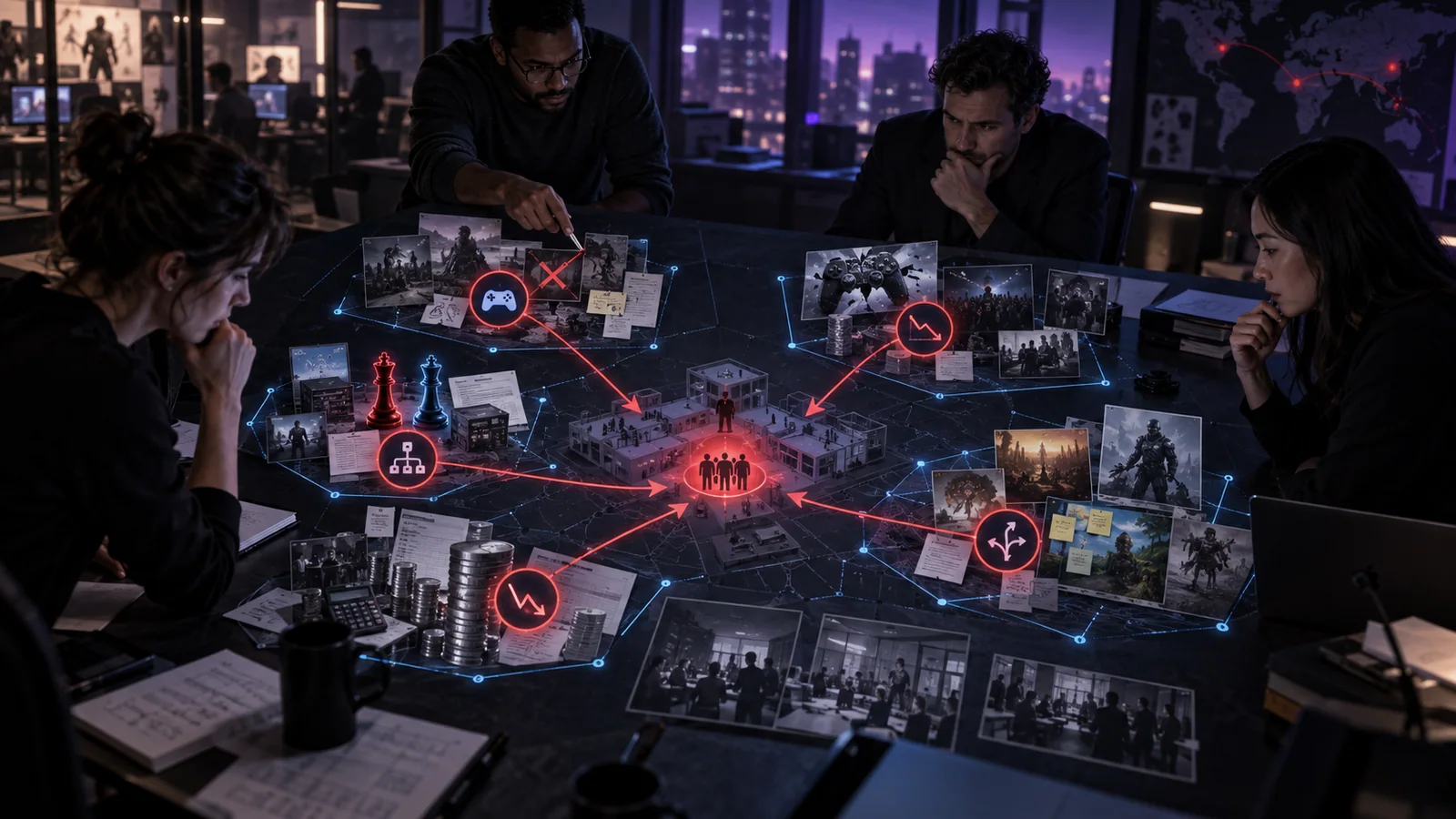
Studios rarely explode in one loud bang. They implode: one delayed milestone, one cancelled project, one hiring freeze, and then a closure announcement that pretends the ending arrived all at once.
The useful question is not, “Was the last game good?” It is, “Which commitments became fixed while the money behind them stayed uncertain?”
Embracer: the paper trail is the story
Embracer Group is unusually instructive because much of the chain is in its own investor material.
The company said it had invested heavily in acquisitions and accelerated organic growth. It also disclosed that a strategic partnership expected to provide more than $2 billion in contracted development revenue over six years did not close on schedule. In June 2023, Embracer announced a restructuring program that explicitly contemplated studio closures, project terminations, lower overhead, and lower game-development investment.
By the end of the program, Embracer reported:
- a cumulative headcount reduction of 1,583;
- about 3,000 additional employees leaving with divested businesses;
- a 45% reduction in its annualized capital-expenditure run rate; and
- discontinued studios, teams, and projects.
That does not prove every affected studio was failing. It proves something more useful: a parent company’s capital-allocation problem can become a studio’s existence problem.
Volition: thirty years did not create immunity
Volition, the studio behind Saints Row and Red Faction, announced its closure in August 2023 after roughly thirty years. Its own announcement tied the decision to Embracer’s restructuring.
The sharp lesson is not that tenure is worthless. It is that history is not runway. A known name, veteran staff, and valuable intellectual property can still lose when the owner needs fewer projects and fewer operating units.
Mimimi: a studio can choose not to repeat the bargain
Mimimi Games tells a different story. After Shadow Gambit: The Cursed Crew, the founders announced that it would be the studio’s final game. Their explanation centered on the personal cost of increasingly ambitious productions and the risk carried by their families.
That was not a parent-company shutdown, and it should not be forced into one. It was a reminder that a sustainable studio must work for the people running it as well as for the spreadsheet.
Four failure modes worth watching
| Failure mode | Public evidence to watch | What the evidence does not prove |
|---|---|---|
| Parent-company contraction | debt targets, capex cuts, divestments, studio reviews | that every affected team performed badly |
| Overextended pipeline | more projects and hiring than shipped cash can support | that one delayed game caused the whole problem |
| Single-project dependence | one title carrying most near-term revenue | that a good launch will automatically save the studio |
| Founder sustainability | repeated crunch, personal-risk statements, voluntary wind-down | that the founders lacked ambition |
The table is a diagnostic, not a law. Studios can close for several reasons at once, and public announcements rarely expose the full internal model.
A five-question pre-mortem
Before adding the next project, studio, or twenty hires, ask:
- Which revenue assumption funds the commitment?
- What happens if that revenue arrives six months late?
- Which cost can actually be reduced without destroying the ship plan?
- Who controls the decision if the studio is owned?
- What would make the founders choose to stop even if the company could continue?
If those answers are vague, the implosion has already found somewhere to start.
FAQ
Can one bad game close a studio?
Yes, especially when one game carries most of the runway. But “the game
flopped” is often the final visible event in a longer chain of commitments,
financing, and ownership decisions.
Is acquisition safer than independence?
It exchanges one risk for another. Independence exposes a studio to its own
runway. Acquisition exposes it to a parent’s portfolio and balance-sheet
decisions.
What is the earliest useful warning sign?
Not gossip: a mismatch between committed burn and believable, timed funding.
Project cancellations, investment reviews, and capex reductions make that
mismatch easier to see from outside.
Studios do not forget how to make games overnight. The business around the games stops carrying its own weight.
Sources
- Embracer’s May 2023 strategic-partnership update
- Embracer’s June 2023 restructuring announcement
- Embracer’s 2023/24 annual report
- Volition’s closure announcement, reproduced by Gematsu
- Mimimi Games: “Our Final Game”
studio closuresgames industrylayoffsEmbracerpostmortem